EDUARDO ALONSO SÁNCHEZ
Developer focused on Rust, applied cryptography and WebAssembly. Currently studying Computer Systems Engineering at ESCOM, IPN.
ACADEMIC BACKGROUND
Computer Systems Engineering
ESCOM · Instituto Politécnico Nacional (IPN)
Computer Systems Technician
CECyT No. 3 (Vocacional 3) · IPN
Coursework completed; técnico title not obtained.
HOBBIES
Web design
Crafting interfaces and front-ends: typography, motion, and the small details that make a site feel right.
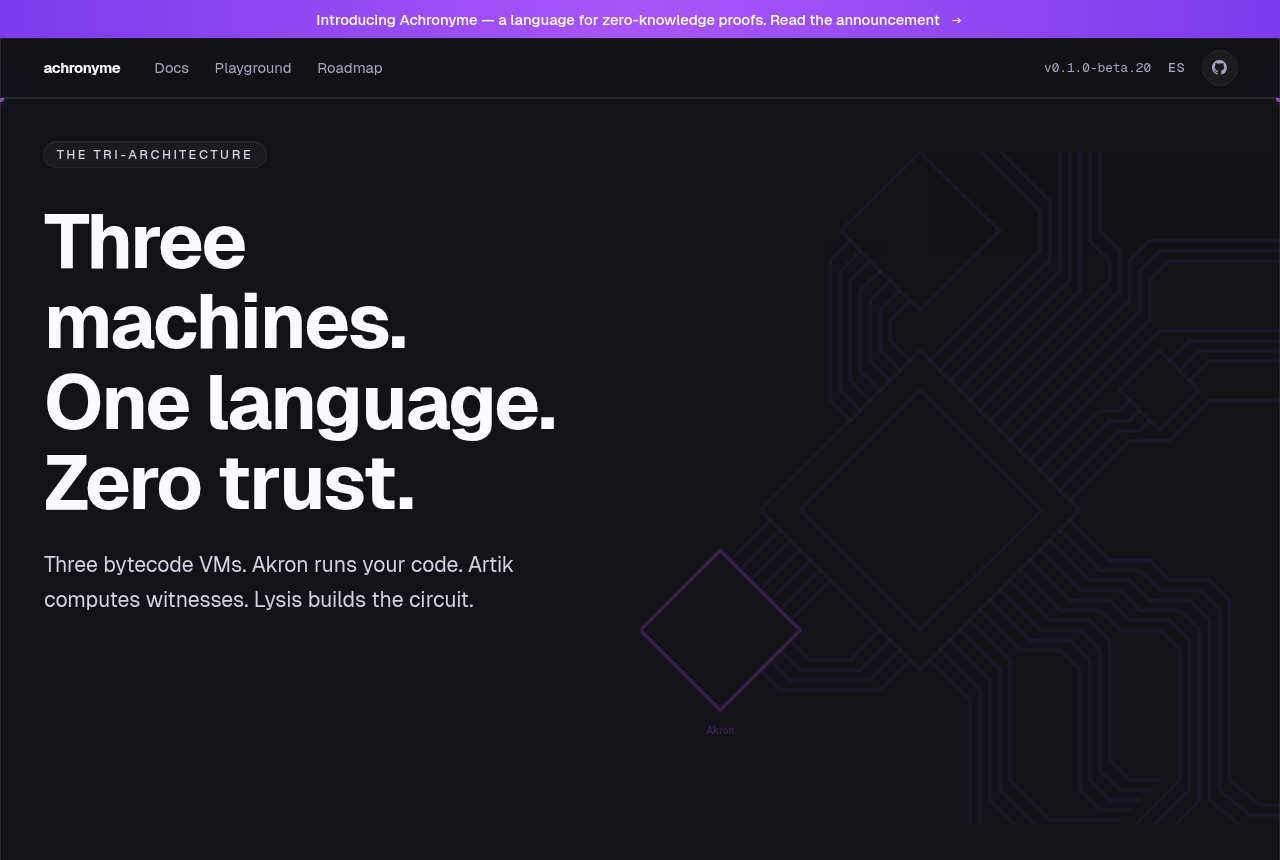
Compilers
Building languages and bytecode VMs — like Achronyme, my zero-knowledge language that compiles to three machines.
Competitive programming
Algorithmic problem solving. LeetCode Guardian, contest rating 2,749 (top 0.05% worldwide).
THE BIRTH OF THE PUBLIC KEY
In 1976, Whitfield Diffie and Martin Hellman published “New Directions in Cryptography” and broke with millennia of secret-key cryptography: for the first time, two people could agree on a shared key over a public channel, having never met before.
A year later, in 1977, Ron Rivest, Adi Shamir and Leonard Adleman found the missing piece at MIT: RSA, the first practical public-key cryptosystem. Its security rests on something easy to state and hard to reverse — multiplying two large primes is trivial, but factoring the product is computationally infeasible. Everyone publishes a modulus n and an exponent e (the public key) and keeps the factorization secret (the private key).
A little-known detail: back in 1973, Clifford Cocks of the British GCHQ had already described an equivalent scheme, but it stayed classified until 1997. Almost half a century later, RSA still encrypts email, signs certificates and protects connections.
The RSA practice on this site implements exactly that scheme — 2048-bit keys and hybrid AES-GCM + RSA encryption — in WebAssembly. My own public key, generated with it, is available to download.
See the RSA practice →